Open-Source ERP in the UAE: Is It Right for Your Company?
Open-source ERP can suit a UAE company that wants flexibility, no per-user software licence fees, and control over where its data is hosted, as long as the company budgets for implementation, hosting, training, and support. It is usually a weaker fit for a business that wants a fixed-price, fully vendor-managed product with very little customisation. The software licence is only one part of the total cost, so the decision should rest on your processes, your people, and your compliance needs rather than on the word ‘free’.
Key takeaways
- Open-source ERP means the source code is publicly available under a licence that lets you use, modify, and share it under set conditions.
- ‘No licence fee’ does not mean ‘no cost’. Implementation, hosting, customisation, training, and support all need a budget.
- The main strengths are flexibility, less dependence on a single vendor, and a choice of hosting.
- The main risks are weak implementation, unmanaged customisation, and unclear responsibility for support.
- Whichever ERP you pick, check VAT, corporate tax, e-invoicing, and data protection requirements before you commit.
What Is Open-Source ERP?
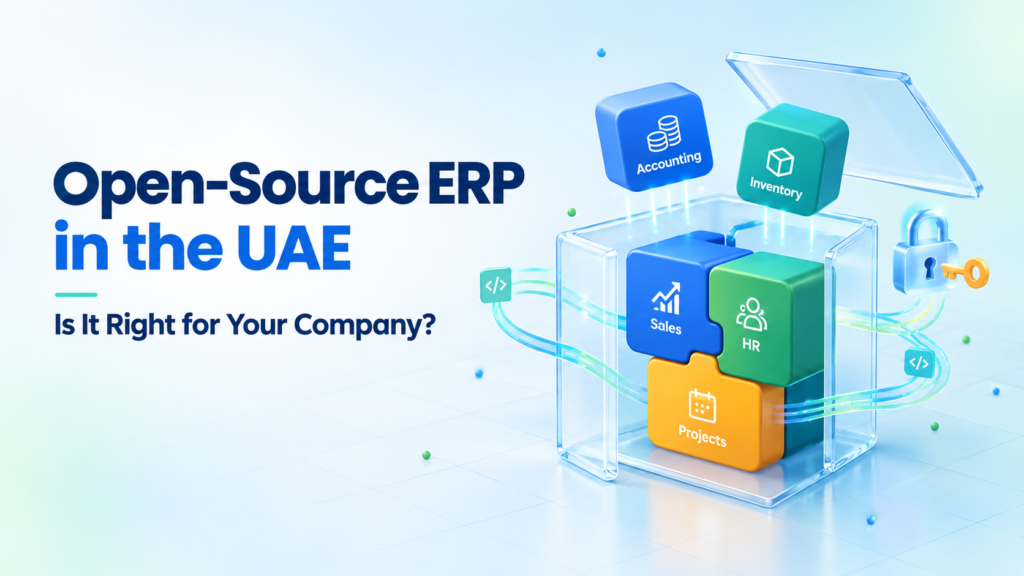
Enterprise resource planning (ERP) software connects core business functions, such as accounting, sales, purchasing, inventory, HR, and projects, in one system that shares a single set of data. Open-source ERP is ERP software whose source code is published under a licence that allows users to inspect, change, and redistribute it under defined conditions.
ERPNext is a well-known example. Its developer, Frappe Technologies, states that the ERPNext code is licensed under the GNU General Public License version 3 (GPLv3), as described on the Frappe Technologies licence and trademark page. The ERPNext documentation lists the freedoms this licence grants: using the software for any purpose, changing it to suit your needs, and sharing it and your changes with others.
Proprietary ERP works differently. The vendor keeps the source code private, and customers buy the right to use the product, usually through subscriptions or per-user terms. Some products sit in between, offering a free edition alongside paid proprietary features. If you are comparing open source ERP UAE options, always check which features belong to which edition.
Open-Source vs Proprietary ERP: A Practical Comparison
Factor | Open-source ERP | Proprietary ERP |
|---|---|---|
Software licence cost | Often none for the software itself | Subscription, per-user, or per-module fees are common |
Source code access | Available for review and modification | Usually closed |
Customisation | Wide scope, limited mainly by skill and budget | Depends on what the vendor allows |
Vendor dependence | Lower, since several partners can support the same software | Higher, since roadmap and pricing are set by one vendor |
Hosting | Self-hosted, partner-hosted, or vendor cloud | Often specified by the vendor |
Support | Through partners, community, or paid plans, and you must arrange it | Usually through a vendor support contract |
Main cost drivers | Implementation, hosting, customisation, support | Licences plus implementation |
Main risk | Poor implementation or unmanaged customisation | Rising renewal costs or limited flexibility |
These are general patterns. Individual products and contracts vary, so compare real quotations rather than categories.
Is Open-Source ERP Really Free?
The software licence may cost nothing, but running an ERP is not free. The ERPNext documentation itself says that although ERPNext is free and open source, running a server for it, implementing it, and supporting it is not an easy task, and it suggests professional help or a service provider to reduce risk.
A realistic budget covers five areas:
- Implementation: process mapping, configuration, chart of accounts, data migration, and testing.
- Hosting: servers, backups, and security updates, or a managed hosting plan.
- Customisation: custom fields, print formats, reports, workflows, and integrations with other systems.
- Training: your staff need time and guidance to use the system well.
- Support and upgrades: someone has to fix issues, apply version upgrades, and answer user questions.
We do not quote generic price ranges here, because costs depend on the number of users, the modules you need, the complexity of your processes, and the volume of data to migrate. Ask for itemised quotations that cover all five areas for both open-source and proprietary options, then compare the total cost over three to five years.
Advantages for UAE Companies
Flexibility for how you actually work. Many UAE businesses, such as trading, contracting, distribution, and facilities management companies, have processes that do not match a standard template. Because the code is open, a capable partner can adapt workflows, documents, and reports to fit your operation instead of forcing you to change it.
Less dependence on one vendor. The ERPNext documentation lists freedom from lock-in with one specific vendor as an advantage of open source. In practice, this means that if you are unhappy with your implementation partner, the software is not tied to that partner, and another qualified provider can take over, provided your configuration is well documented.
Choice of hosting. The same documentation notes that you can host the application anywhere, including on your own server, to keep ownership and privacy of your data. For companies that want to decide where their data sits, this choice matters.
Start small and grow. You can begin with core areas such as accounting, sales, purchasing, and inventory, then add others like HR or projects later. Under an open-source licence, adding a module does not require buying another licence, although configuration and training still carry a cost.
Reviewable code and a community. Public code can be inspected by many people, and a wider community reports issues and suggests improvements. This helps transparency, but it does not replace proper security practice, as the next section explains.
Limitations and Risks to Weigh
Results depend on implementation quality. An ERP is only as good as its setup. Weak requirements gathering, rushed data migration, or poor training will cause problems with any software, open-source or not.
Heavy customisation can slow future upgrades. Every custom change is something that must be tested and maintained when the core software updates. Customise where it adds real value, and keep the rest standard.
Support is something you arrange. There is no automatic support contract. You need to agree who answers questions, who fixes defects, and how quickly, either with a partner or through a paid plan from the software developer.
Security is a shared responsibility. Public code is not automatically insecure, and closed code is not automatically safe. What matters is how the system is hosted, patched, backed up, and monitored, and who controls user access. If you self-host, someone must own those tasks.
Niche industry gaps may need development work. If your sector has very specific requirements, you may need custom development, which adds cost and time.
Licence obligations exist. The next section explains them in plain language.
The GPL Licence in Plain Language
GPLv3 is a copyleft licence. Frappe states that modifications to the ERPNext codebase must be distributed under the same GPLv3 licence. In general, GPL obligations apply when software is distributed to other parties, not when a company runs a customised version for its own internal use. Companies that plan to resell, package, or share modified ERP code should take legal advice first.
The ERPNext name and logo are also trademarks of Frappe Technologies, and the company publishes usage rules for them. You can read the full licence text on the GNU licences page. This section is general information and not legal advice.
UAE-Specific Questions to Ask Before Choosing Any ERP
VAT and corporate tax. Your ERP should handle tax codes, tax invoices, and the reports your accountant needs. Ask any vendor or partner to demonstrate real UAE VAT scenarios, such as zero-rated sales, reverse charge, and credit notes, rather than relying on a feature list.
E-invoicing. The UAE is introducing a mandatory e-invoicing system in phases. According to the UAE Ministry of Finance announcement carried by WAM on 10 May 2026, the deadline to appoint an Accredited Service Provider was extended from 31 July 2026 to 30 October 2026. The Ministry also confirmed that entities with annual revenue above AED 50 million must fully implement the system by 1 January 2027. The rollout is phased, so check which phase applies to your company, and confirm the current rules with the Ministry of Finance, because dates and requirements can change. For any ERP you consider, ask how it will connect to an accredited provider and who is responsible for that integration.
Data protection. Federal Decree-Law No. 45 of 2021 governs personal data protection in the UAE, and the text is available on the UAE Legislation portal. Customer, supplier-contact, and employee records in your ERP are likely to count as personal data. Some free zones, such as DIFC and ADGM, have their own data protection regimes, so confirm which rules apply to you. Ask where your data will be hosted, who can access it, and how backups are handled.
Arabic and bilingual documents. If you issue Arabic or bilingual invoices, quotations, or contracts, test those print formats during the demo instead of assuming they work.
Which Businesses Are a Good Fit?
Open-source ERP tends to suit a company that:
- has processes that need adapting rather than a standard template;
- expects its user count to grow and wants to avoid per-user software fees;
- has, or will hire, a capable implementation partner or in-house IT support;
- wants a say in where its data is hosted;
- is willing to invest time in defining requirements, testing, and training.
It tends to be less suitable if a company:
- wants a rigid, ready-made product with minimal configuration and a single vendor accountable for everything;
- has nobody inside the business who can own the project;
- cannot commit time to requirements and testing;
- operates under rules that require specific certified software, in which case you should check the requirement first.
What Do Real Implementations Look Like?
Accruon’s published case studies show the kinds of problems businesses bring to an ERP project. A medium-sized import and export business faced manual data-entry errors, delayed financial reports, and inefficient inventory processes, as described in the trading company case study. A perfume manufacturer dealt with inaccurate stock valuation and mismatches between physical and accounting records, covered in the perfume manufacturing case study. A UAE construction company struggled with project tracking, manual accounting, and limited reporting, described in the construction firm case study.
These are accounts of specific clients using ERPNext, and results differ from company to company. You can also browse our client for the types of businesses we work with.
Ten Questions to Ask Before You Decide
- Which processes must the ERP handle on day one, and which can wait?
- What is the total cost over three to five years, including implementation, hosting, support, and upgrades?
- Who will own the project inside our company?
- Where will our data be hosted, and who can access it?
- How will the system handle UAE VAT and corporate tax reporting?
- How will it connect to the UAE e-invoicing system if we fall within its scope?
- Which customisations are truly necessary, and who will maintain them?
- How will existing data from spreadsheets or older software be cleaned and migrated?
- What training will each team receive, and how long will it last?
- If we want to change partners later, can we get our data and the customisation documentation?
How to Choose an Implementation Partner
For open-source ERP, the partner often matters more than the software. Look for these signs:
- Accounting competence. An ERP is a financial system first, so the team should understand accounting, not only code. Accruon’s team includes chartered accountants, cost accountants, and management accountants alongside technical staff, as described on our ERPNext implementation page.
- A written scope. It should define modules, customisations, data migration, training, and support.
- Verifiable references. Ask to speak with clients in a similar industry.
- Clear responsibility for hosting, backups, and upgrades.
- Fair exit terms. You should be able to retrieve your data and receive documentation of your setup.
- Verified partner status. You can check ERPNext partners in the UAE on the Frappe partner directory, including the Accruon Consultant LLC profile.
Open-source ERP is neither a shortcut nor a risk to avoid. It is a different way to buy and run business software, and it rewards companies that prepare well. If you value flexibility, hosting choice, and independence from a single vendor, and you are ready to invest in a sound implementation, it deserves a serious look. If you want a fixed, vendor-managed product with minimal change, a proprietary option may suit you better.
If you would like to talk through your situation, you can explore our ERPNext implementation service, read about our approach to digital transformation and business automation, learn about Accruon, or contact our team to request a demo. For more guides, visit our blog.
This article is general information and does not constitute legal, tax, or financial advice. Regulations and deadlines can change, so please confirm current requirements with the relevant UAE authority or a qualified adviser.
FAQ
What is open-source ERP?
Open-source ERP is business management software whose source code is publicly available under a licence that lets you use, modify, and share it under stated conditions. It usually covers accounting, sales, purchasing, inventory, and other functions in one system.
Is ERPNext free to use?
The ERPNext software is released under GPLv3 and does not carry a software licence fee. You still need to pay for implementation, hosting, customisation, training, and support, either from a partner or from your own team.
Is open-source ERP safe for a UAE business?
Safety depends on how the system is hosted, patched, backed up, and accessed, not only on whether the code is open. Ask any provider about security updates, access controls, backups, and data location.
Can open-source ERP handle UAE VAT?
It can be configured for VAT, but you should verify this through a live demonstration of your own scenarios, and confirm the setup with your accountant.
Can a small business use open-source ERP?
Yes, if it has the time to define its processes and a partner or staff member who can support the system. Smaller companies often benefit from starting with a limited set of modules.
What happens if my implementation partner stops working with us?
Because the software is open source, another qualified provider can usually take over, but this works best when your configuration, customisations, and credentials are properly documented from the start.