ERP Software Dubai: A Complete Guide for Businesses Choosing the Right ERP Solution
If your team is juggling spreadsheets, a standalone accounting package and a separate tool for stock, you have probably already asked whether ERP software in Dubai is the next step. Dubai’s business environment moves quickly: new customers, new suppliers, VAT and corporate tax obligations, and growing e-invoicing requirements all add to the daily workload. When each department keeps its own records, the cost shows up as re-keyed data, delayed reports and decisions made on figures that are already out of date.
An ERP (Enterprise Resource Planning) system brings finance, inventory, sales, purchasing, HR and reporting into one platform with one set of data. It does not fix a weak process on its own, and it is not a switch you flip. But when it is chosen carefully and implemented properly, it gives owners and managers a reliable, shared view of the business.
This guide explains what ERP is, what to look for, how implementation works, and how to avoid the mistakes we see most often when UAE companies choose a system.
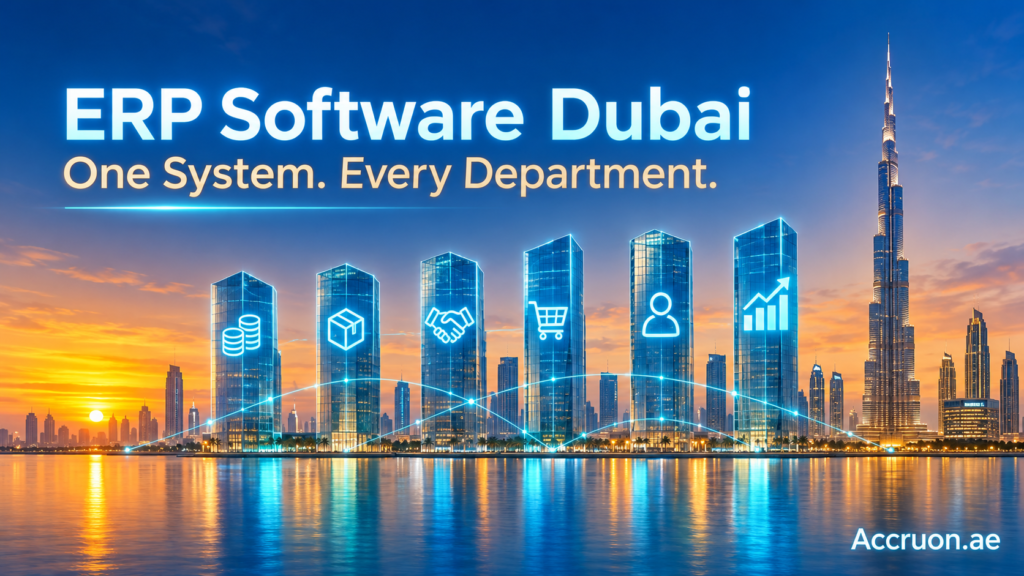
Common ERP modules
Most ERP system platforms in Dubai are modular, so you can start with what you need and add more later:
- Accounting and finance: general ledger, payables, receivables, bank reconciliation, VAT and multi-currency support.
- Inventory management: item masters, stock movements, warehouses, batches and serial numbers.
- Sales management: quotations, sales orders, delivery notes and invoicing.
- Purchase management: purchase requests, supplier orders, goods receipt and bills.
- Customer relationship management (CRM): leads, opportunities, customer history and follow-ups.
- Human resources: employee records, attendance, leave, payroll and expense claims.
- Reporting and analytics: dashboards and reports drawn from live transactions.
Why Businesses in Dubai Need ERP Software
Not every company needs ERP on day one. A very small business with a handful of invoices a month may manage with simple accounting software. The need usually appears as the business grows. Typical signs include:
- Growth is adding complexity. More products, more customers, more warehouses or more staff make manual tracking harder to control.
- Visibility is limited. Management cannot see current stock, outstanding payments or project costs without asking several people.
- Repetitive work is consuming time. Re-entering orders, reconciling spreadsheets and chasing approvals by email take hours that could go elsewhere.
- Departments are not aligned. Sales promises stock that purchasing has not ordered; finance learns about a large order after delivery.
- Information arrives late. Month-end reports take days to prepare, so decisions rely on old numbers.
- Compliance is getting more demanding. VAT records must be accurate, and the UAE is rolling out structured e-invoicing through the Federal Tax Authority and Ministry of Finance. Rollout timelines are phased, so confirm current requirements on the Federal Tax Authority website before planning.
It is worth being realistic. ERP improves visibility and reduces manual work, but it does not guarantee higher profit or remove the need for good processes and trained people. The results depend on how well the system is set up and used.
Important Features to Look for in ERP Software in Dubai
Feature lists can be long and confusing. Focus on the areas that match how your business actually operates.
Financial management
Accounting is the backbone of any ERP. Look for:
- A flexible chart of accounts and clean double-entry bookkeeping.
- Support for UAE VAT, including TRN on documents and VAT reporting.
- Expense tracking with approvals and categories.
- Multi-currency handling, which matters for companies that buy or sell in USD, EUR or other currencies.
- Standard financial statements (profit and loss, balance sheet, cash flow) that you can filter by period, cost centre or project.
Good financial control means fewer surprises at period end and an easier conversation with your auditor.
Inventory management
For trading, retail and manufacturing companies, accounting and inventory management software in Dubai often needs to work as one system. Check for:
- Real-time stock levels across warehouses and locations.
- Reorder levels and purchase tracking from request to receipt.
- Batch, serial number and expiry tracking where relevant.
- Landed cost handling for imported goods.
- Clear supply chain visibility, so you can see what is on order, in transit and in stock.
Sales and customer management
- A visible sales pipeline from enquiry to quotation to order.
- Central customer records with contact history, pricing and credit terms.
- Order tracking, so the team can answer “where is my order?” without searching through emails.
Analytics and reporting
- Live reports instead of manually compiled spreadsheets.
- Dashboards for sales, receivables, stock and cash position.
- The ability to build custom reports as your questions change.
Also ask about Arabic and English document support, user permissions, mobile access and the ability to integrate with banks, payment gateways or e-commerce platforms.
Benefits of ERP Solutions for Dubai Businesses
When implemented well, ERP solutions in Dubai can offer practical, everyday benefits:
- Better workflow management: approvals, orders and documents follow a defined path instead of living in inboxes.
- Stronger collaboration: sales, warehouse, purchasing and finance see the same information.
- Less data duplication: details are entered once and reused across the system.
- More organised processes: the system encourages consistent ways of working.
- More accurate reporting: reports come from transactions, not manually merged files.
- Room to scale: adding users, branches, companies or modules is easier on a single platform.
These benefits are not automatic. They appear when the team actually uses the system and the processes behind it are well defined.
How to Choose the Right ERP Software Company in Dubai
Selecting the implementation partner is as important as selecting the software. The same ERP can succeed in one company and struggle in another because of how it was configured, how data was migrated and how users were trained. When you evaluate an ERP software company in Dubai, look at:
- Industry experience: have they worked with businesses similar to yours, such as trading, manufacturing or services?
- Understanding of UAE requirements: VAT, corporate tax, free zone and mainland structures, Arabic documents, WPS payroll and e-invoicing readiness.
- Customisation capability: can they adapt the system to your workflow without making it fragile or hard to upgrade?
- Implementation approach: do they run a structured process with defined scope, milestones and sign-offs?
- Data migration support: who cleans and imports your customers, suppliers, items and opening balances?
- Employee training: is training included, and is it role-based?
- After-sales support: what happens after go-live? Ask about response times and how issues are handled.
- Long-term scalability: will the platform and the partner still fit when you double in size?
Ask for references, a clear scope document and an honest explanation of what is included, and what is not.
ERP Implementation in Dubai: Step-by-Step Process
ERP implementation in Dubai follows a similar path regardless of the software. Timelines vary with the number of users, modules, data volume and customisation, so be cautious of anyone promising a go-live date before understanding your business.
- Business requirement analysis: document current processes, pain points and reporting needs with the people who do the work.
- ERP software selection: compare options against your requirements, budget and growth plans.
- Planning and project scope: define modules, users, integrations, responsibilities and a realistic schedule.
- Data preparation and migration: clean master data (customers, suppliers, items, opening balances) before importing it.
- System configuration and customisation: set up the chart of accounts, taxes, workflows, roles and any custom fields or reports.
- Testing: run real scenarios end to end, such as a full sales cycle and a purchase-to-payment cycle, and fix issues before go-live.
- Employee training: train users on the processes they will actually perform.
- Deployment: go live, often with a cut-off date and close support during the first weeks.
- Continuous improvement: review usage, refine workflows and add modules as the business needs them.
Skipping early steps, especially requirement analysis and data preparation, is the most common reason projects run over time.
Why Businesses Consider Open Source ERP Solutions Like ERPNext
Open source ERP software means the source code is publicly available and can be used and modified under an open licence. There is no per-user licence fee for the software itself, though you still pay for implementation, hosting, customisation and support.
ERPNext, built on the Frappe framework, is one of the best-known open source ERP platforms. Businesses in the UAE look at it for several reasons:
- Flexibility: custom fields, workflows and print formats can be configured to fit your process.
- Customisation: because the code is open, developers can extend it to meet industry or compliance needs.
- Breadth: accounting, stock, sales, purchasing, CRM, HR and projects sit in one system.
- Transparency: there is no vendor lock-in to proprietary code.
It tends to suit small and mid-sized trading, manufacturing and service companies that want a configurable system and are prepared to invest in a proper implementation. It is not automatically the right answer for every company. Very specialised industries, complex group structures or specific integration needs should be assessed carefully against alternatives. You can review the official ERPNext documentation to understand modules and capabilities before deciding.
Open source also raises the importance of professional support. Without good configuration, UAE-specific setup and ongoing maintenance, even a capable platform will underdeliver. Accruon provides ERPNext Implementation Services in UAE for companies that want guidance through each stage.
Common Mistakes to Avoid When Selecting ERP Software
- Choosing only on price. The cheapest quote often leaves out data migration, training or support, which return as extra costs later.
- Ignoring future requirements. A system that fits today may not handle a second warehouse, a new entity or e-invoicing next year.
- Not checking customisation needs. Find out early where your process differs from standard workflows and how that will be handled.
- Poor implementation planning. Unclear scope, no internal project owner and rushed timelines lead to delays.
- Lack of employee training. A well-configured system still fails if people keep working in spreadsheets.
- Not evaluating support. Ask who responds when something breaks after go-live, and how quickly.
ERP Software Dubai for Different Industries
The best setup depends on how your business earns and spends money. Typical focus areas:
- Trading companies: purchase and import tracking, landed cost, multi-currency pricing, stock across warehouses and customer credit control. See how this looks in practice in Accruon’s trading company case study.
- Manufacturing companies: bills of materials, work orders, raw material consumption and costing, with stock linked to production.
- Logistics companies: job and shipment tracking, vendor payables, multi-currency billing and cost control by job or route.
- Retail businesses: item and price management, multiple outlets, stock transfers and sales reporting by branch.
- Service companies: project and timesheet tracking, recurring billing, expense management and profitability by client.
Faq
What is the best ERP software in Dubai?
There is no single best option. The right choice depends on your industry, team size, budget, compliance needs and growth plans. Compare a shortlist against your documented requirements and test with real scenarios.
How long does ERP implementation take in Dubai?
It depends on scope. A small team with a limited set of modules can be live sooner than a multi-branch company needing customisation and integrations. A reputable partner will estimate after a requirements review, not before.
Is open source ERP suitable for SMEs in Dubai?
Often yes, particularly for companies that value flexibility and want to avoid per-user licence fees. It still requires proper implementation, UAE-specific configuration and reliable support.
Does ERP software help with UAE VAT?
Most modern ERP systems support VAT on invoices and reports, but setup matters. Confirm how tax templates, TRN fields and reporting are handled, and check current guidance on the Federal Tax Authority website.