UAE Corporate Tax Record Keeping in ERPNext: What the FTA Can Ask For
UAE Corporate Tax record keeping is the part of compliance that keeps working long after the return is filed. The 30 September 2026 deadline for 31 December 2025 year-ends has passed, but the Federal Tax Authority (FTA) can still ask you to prove any figure in that return, and the real test is speed: can your team produce the evidence in days, not weeks? If your books run on ERPNext, most of the answer is already in the system. This guide explains what the FTA expects and gives you a four-request drill, about 30 minutes long, to test your readiness.
The FTA has said taxable persons must keep records that support their returns. It names four in particular: a record of transactions during the tax period, an asset register showing purchases and disposals, a record of liabilities, and a record of shares or ownership interests at period end. These records let the FTA verify revenue, taxable income and eligibility for Small Business Relief. Persons exempt from Corporate Tax must also keep records proving they meet the conditions for exemption.
Returns and payment are due within nine months of the end of the tax period, so the records should exist well before that point. You can confirm the current rules on the FTA website.
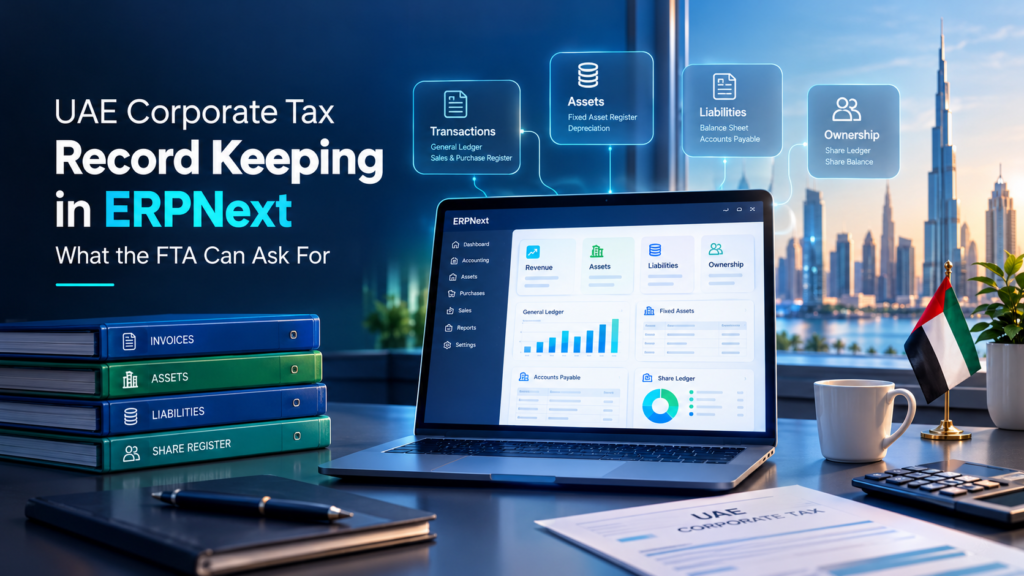
The Four-Request Drill
Imagine the FTA sends four requests. For each one, time how long your team takes to answer from ERPNext. Report names can vary slightly between versions, so check them in your own instance.
Request 1: "Show us every transaction behind your revenue"
Open the General Ledger, filter to income accounts and the tax period, then drill from each line into its source voucher. The Sales Register gives invoice-level totals, and the UAE VAT 201 report lets you reconcile VAT-reported sales to ledger revenue. Pass test: every ledger line opens a source document with its contract or delivery proof attached, and any gap between VAT and ledger revenue is explained. See our guide to ERPNext for UAE VAT for the VAT side.
Request 2: "Show us your asset register"
ERPNext’s Asset module holds each asset’s category, cost, capitalisation date, useful life and depreciation schedule. The Fixed Asset Register and Asset Depreciation Ledger reports present them. Pass test: every capital purchase in the ledger has an asset record, and every disposal was posted through the asset rather than as a loose journal entry.
Request 3: "Show us what you owe"
Start with the Balance Sheet, then support it with Accounts Payable ageing and the General Ledger filtered to liability accounts for accruals, loans and advances received. Pass test: each balance traces to a supplier statement, a loan agreement or a dated accrual, and related-party balances sit in their own accounts instead of trade payables.
Request 4: "Show us who owns the company"
This record often lives in a Word file outside the ERP. ERPNext can hold it: record each Shareholder, log changes through Share Transfer, and show period-end holdings with the Share Ledger and Share Balance reports. Pass test: the closing share register agrees with your trade licence and Memorandum of Association.
Request | Main ERPNext source | You pass when |
|---|---|---|
Transactions | General Ledger, Sales and Purchase Register | Every line has a source document |
Assets | Fixed Asset Register | Every capital purchase is capitalised |
Liabilities | Balance Sheet, Accounts Payable | Every balance has evidence |
Ownership | Share Ledger, Share Balance | Register matches licence and MOA |
Proving Nothing Changed After the Fact
Records are only credible if they cannot be quietly altered. In ERPNext, submitted documents are corrected by cancelling and amending, not deleting, and version history shows who changed what and when. The Audit Trail report and Deleted Documents list give an independent view, while role permissions and a closed accounting period stop backdated postings once a year is signed off.
Also check how long you retain data. The FTA has stated that records must be kept for at least seven years after the end of the tax period they relate to, while VAT records are generally kept for five years. Some real estate records carry longer periods, so confirm yours with the FTA, and make sure your backups never purge records earlier.
Why UAE Corporate Tax Record Keeping Matters More From 2027
Two changes raise the stakes. The amended Tax Procedures Law applies from 1 January 2026 and widens the FTA’s powers, and UAE e-invoicing becomes mandatory from 1 January 2027 for businesses with revenue of AED 50 million or more, followed by smaller businesses from 1 July 2027. Structured invoice data will give the authority a direct view to compare against your ledger, so mismatches become easier to spot. Our posts on UAE e-invoicing with ERPNext and choosing an Accredited Service Provider cover that preparation. The Ministry of Finance publishes the official guidance at mof.gov.ae.
Turn the Drill Into a Monthly Habit
Run this short routine at every month-end:
- Confirm the Trial Balance balances.
- Reconcile the UAE VAT 201 report to ledger revenue.
- Check the Fixed Asset Register for purchases not yet capitalised.
- Match key supplier balances to statements.
- Review the Audit Trail report, then lock the period.
Faq
What records must you keep for UAE Corporate Tax?
The FTA names a record of transactions, an asset register, a record of liabilities, and a record of shares or ownership interests, plus any document supporting figures in your return. In ERPNext these map to the General Ledger, Fixed Asset Register, Accounts Payable and Share Ledger reports.
How long must you keep UAE Corporate Tax records?
At least seven years after the end of the tax period the records relate to, according to the FTA’s official reminder. The clock starts when the tax period closes, not when you file. This applies to exempt persons too.
When are UAE Corporate Tax returns due?
Within nine months of the end of the tax period. For a financial year ending 31 December 2025 the deadline was 30 September 2026, and for a year ending 31 December 2026 it will be 30 September 2027. Filing and payment happen on the FTA’s EmaraTax platform.
Can you keep UAE Corporate Tax records electronically in ERPNext?
Digital records are standard practice, provided they are complete, accurate and can be produced when the FTA asks. ERPNext helps through attachments, version history and an audit trail. Confirm format requirements in current FTA guidance, and see our ERPNext for UAE Corporate Tax page.
Do small businesses and exempt persons still need to keep records?
Yes. The FTA has said businesses eligible for Small Business Relief must keep records so it can verify revenue and eligibility. Exempt persons must keep records proving they meet the conditions for their exemption.
What happens if you do not keep proper Corporate Tax records?
The FTA has warned that failing to keep required records can lead to administrative penalties. Amounts depend on the current penalty decisions, so check the exact figures on the FTA website before relying on any number you read elsewhere.
Does ERPNext file your Corporate Tax return?
No. Returns are filed through EmaraTax. What ERPNext does is hold the ledgers, asset register and ownership records that support the return, so preparing and defending it is faster. A Chartered Accountant-led ERPNext implementation sets that up correctly from the start.
Good UAE Corporate Tax record keeping is simply accounting done in a form you can prove. ERPNext supplies the structure, but chart of accounts design, asset categories, permissions and closing rules decide whether it holds under review. As a Chartered Accountant-led ERPNext implementation partner, Accruon sets these up around UAE tax requirements from day one. Read more in our guide to ERP for UAE Corporate Tax compliance, explore ERPNext for Corporate Tax, or let our bookkeeping team maintain the records for you. To test your own setup, contact Accruon. For report details, the official Frappe documentation is the best reference.