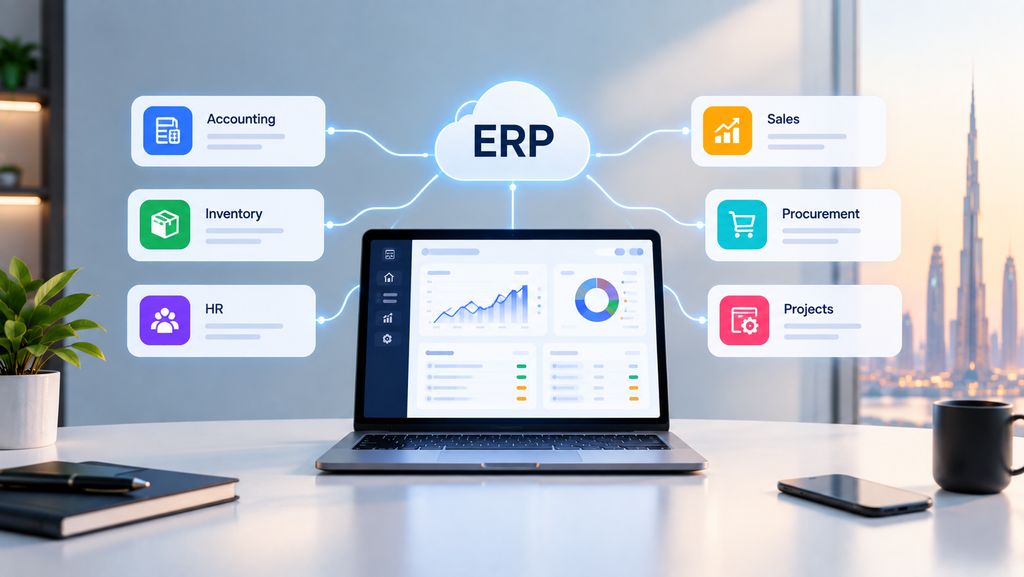
If you run a business in the UAE, this probably sounds familiar: accounts sit in one accounting tool, inventory lives in a spreadsheet, HR records are tucked away in another file, and sales updates just come through WhatsApp or email. Each of these works fine on its own, but they don’t talk to each other. When you finally need a complete overview of your business, you copy numbers from five different places and hope they match.
This disconnect is one of the main reasons businesses look into ERP systems like ERPNext — not because spreadsheets are bad tools, but because they become unmanageable once a business grows past a certain size.
ERPNext UAE: Solving the Real Problem of Disconnected Systems, Not Bad Tools
Most businesses don’t struggle because of weak individual tools. The accounting software handles accounting well. The inventory sheet tracks stock accurately. The real issue is that none of these tools were ever built to work together. So someone ends up copying data from one to the other by hand, and that’s where things go wrong — delays creep in, figures stop matching, and small errors sit unnoticed until month-end rolls around.
ERPNext addresses this by bringing core business functions — finance, sales, inventory, procurement, HR, and projects — onto a single platform where data updates automatically across departments. A recorded sale can reflect in inventory. Low stock can trigger a flag for procurement. When payroll runs, it links back to the books. Nothing needs to be entered twice. This is exactly the kind of consolidation businesses have in mind when they start evaluating ERPNext UAE as an alternative to running five separate systems.
What This Actually Changes Day to Day
It’s worth being upfront here: an ERP system doesn’t fix a broken process, and it won’t run your business for you. What it does is give every department access to the same live data, instead of six separate versions of the truth.
For a finance team, this means reports reflect current inventory and sales figures without waiting on updates from other departments. For operations, it means real-time visibility into stock instead of relying on periodic manual counts. For management, it means decisions are based on today’s numbers, not last month’s spreadsheet export.
Why This Matters More Under UAE Regulations
For UAE businesses, this level of visibility has shifted from a convenience to a practical necessity. With VAT and Corporate Tax reporting now a standard part of doing business, keeping accurate, audit-ready records isn’t optional — it’s a compliance requirement. The current VAT framework is detailed directly on the Federal Tax Authority‘s website, and the Corporate Tax rules are published on the official Ministry of Finance website. That’s a big reason more UAE businesses are turning to ERPNext UAE setups now — they need reporting that holds up to scrutiny, not numbers pulled together from scattered spreadsheets at the last minute.
Why Businesses in the ERPNext UAE Market Are Considering ERPNext Specifically
One reason ERPNext keeps coming up in these conversations is that it’s open-source — small and mid-sized businesses like that they’re not locked into the cost or rigidity of the bigger enterprise platforms. Frappe Technologies builds and maintains it, and because it’s modular, a business can start with just finance and inventory, say, and bring in other modules later instead of paying for a full suite before they’re ready to use it.
Why ERP Implementation Matters More Than the Software You Choose
That flexibility is a real advantage, but it also puts a lot of weight on getting the implementation right. An ERP system set up without a clear understanding of a business’s actual workflows and compliance obligations can end up just as disconnected as the spreadsheets it replaced. How well the system gets set up and configured, more than the software itself, is usually what decides whether it actually pays off.
A proper rollout is never just install-and-go. It means sitting down with each department to understand how they actually work, building the system structure around that reality (chart of accounts, approval workflows, cost centers), moving over existing data carefully, and training staff well enough that they actually use the system correctly from day one. You can review our full approach in the ERPNext implementation methodology. Skipping any of these steps is usually why ERP projects underdeliver.
There’s No One-Size-Fits-All Setup
Different businesses have different operational needs depending on their industry — trading, manufacturing, and construction each work differently day to day. You can see how this plays out across sectors in our client case studies, including a trading company, a perfume manufacturing business, and a construction firm. These examples also show why a generic template rarely works — an ERPNext UAE setup needs to reflect how each specific industry actually operates. If your operations still involve manual back-office work like bookkeeping and reconciliation, it’s worth considering how that fits alongside an ERP rollout — our back office and bookkeeping service is often paired with implementation for exactly this reason.
ERPNext UAE: Should You Consider It?
If you’re currently juggling disconnected tools and spending real hours reconciling numbers between them, it’s worth evaluating whether a unified system would reduce that overhead. It won’t fix every operational problem on its own, and it does take real commitment to set up and staff training. But if you’ve outgrown spreadsheets and need reporting you can actually rely on, it’s worth looking into.
If you’re weighing your options, our ERPNext implementation service outlines the process in more detail, or you can get in touch to discuss whether it fits your setup.